By New Delhi Chronicle Desk
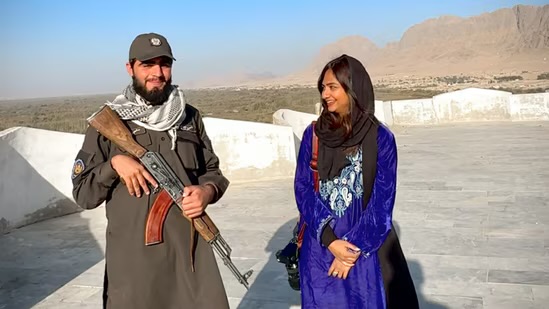
In an era where social media feeds are dominated by curated, picture-perfect vacation spots, Indian travel content creator and filmmaker Sharanya Iyer chose a radically different path. Known online as ‘TrulyNomadly’, the 36-year-old travel vlogger recently completed a raw, eye-opening two-week journey through Afghanistan.
Sharanya, who quit her corporate job in 2019 to pursue full-time travel, made it clear that her intention was never to romanticize or sanitize the conflict-torn nation. Instead, her experience sheds light on the stark duality of modern Afghanistan—a country defined by its deep hospitality but overshadowed by extreme systemic restrictions.
“No Whitewashing”: The Reality of Women Under the Taliban
Since regaining control of Afghanistan in August 2021, the Taliban has enforced a strict interpretation of Islamic law. This has drastically dismantled the freedoms of Afghan women and girls, who are currently banned from attending schools past the sixth grade and barred from higher education. Women are also prohibited from entering public spaces like parks, gyms, and beauty salons, and cannot travel long distances without a male guardian (mahram).
“One thing I consciously didn’t want to do was return from Afghanistan and present only a whitewashed version of the country,” Sharanya shared. While criticizing some Western travelers for presenting only a polished narrative, she noted, “Does Afghanistan have beautiful places? Absolutely. Are the people warm and hospitable? Absolutely. But does that mean we stop talking about what’s happening to women there? I believe the answer is no.”
From Kabul to Kandahar: Logistics and the Cost of Travel
Sharanya’s deep fascination with the region stems from the classic literature she consumed growing up, ranging from Rabindranath Tagore’s Kabuliwala to the moving novels of Khaled Hosseini. Her perspective on traveling to heavily sanctioned nations evolved after a solo backpacking trip through Iran in 2022, where she learned to separate everyday citizens from their ruling governments.
Departing from New Delhi, Sharanya flew directly to Kabul on the Afghan carrier Kam Air. Over her 12-to-13-day itinerary, she explored historic and architectural landmarks, including:
• The Bamiyan Valley, standing before the empty niches where the ancient giant Buddha statues once stood.
• The Panjshir Valley, Ghazni, and the Taliban stronghold of Kandahar.
The entire journey cost approximately ₹2.1 lakh, covering flights, accommodation, permits, and food. Because she was filming, she hired a private local guide and driver—a strict requirement enforced by the regime. Traveling between provinces requires rigorous documentation, with the Taliban inspecting permits at various checkpoints.
Hospitality Amidst a Silent Crisis
For tourists, the experience can feel entirely separate from the oppression faced by locals. Sharanya recalled the immense warmth of ordinary Afghans, who frequently refused to let her pay for meals because of their fondness for Indians.
However, the invisible barriers remained palpable. “In Kabul, I still saw women walking to the market in pairs wearing burqas. Outside of Kabul, I did not see any women unless they were accompanied by men,” she revealed. Furthermore, public spaces like parks were completely devoid of women. Even in restaurants, segregation was strictly enforced, requiring her to dine in the men’s section alongside her guide.
The Desire for Escape vs. The Need for Stability
During her interactions in local markets, Sharanya encountered a heartbreaking theme: a desperate desire for escape. Many fathers quietly approached her, asking for financial aid or assistance with Indian visas to secure a future and education for their young daughters.
Concurrently, she encountered residents who supported the current regime due to the peace it established after decades of continuous foreign intervention and civil war. “When I spoke to locals, many of them told me that, for the first time in years, they weren’t living with bombs, violence, or constant war,” she noted.
Why Tourism is an Economic Lifeline
Despite the political and personal risks of sharing critical social media commentary, Sharanya strongly argues against isolating Afghanistan.
“I think the biggest takeaway for me is that you cannot boycott an entire country because of its regime, however horrific its laws may be,” she concluded. “If we completely stop visiting places like Afghanistan, I believe we’re further isolating ordinary people and taking away whatever little opportunity they have to earn a livelihood.”
While emphasizing that Afghanistan requires high travel experience and extreme logistical flexibility, Sharanya encourages travelers to keep an open mind, reminding them that travel is ultimately about connecting with the people, not just the politics.