By Chronicle News Service | New Delhi
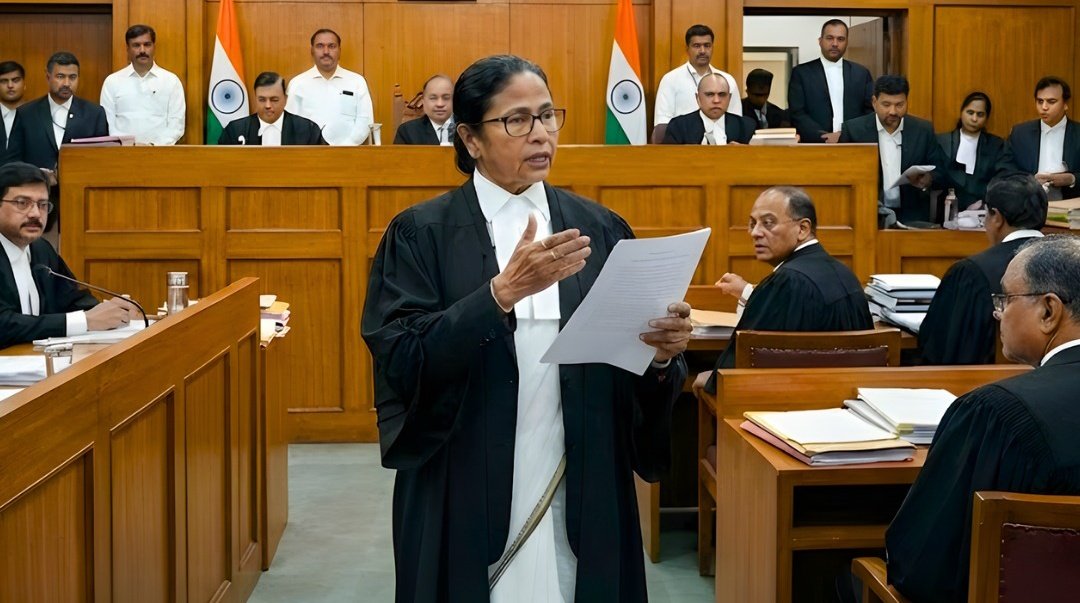
In an unprecedented move that blurred the lines between political activism and legal advocacy, West Bengal Chief Minister Mamata Banerjee appeared before the Supreme Court on Wednesday, arguing her own case against the Election Commission of India (ECI).
Draped in a signature white sari and a black shawl—a garment she described as a symbol of protest—Banerjee transformed the apex court’s Courtroom No. 1 into a theater of democratic debate. Her appearance marks the first time a sitting Chief Minister has argued in person before the Supreme Court, challenging the Special Intensive Revision (SIR) of electoral rolls in Bengal ahead of the state’s high-stakes Assembly elections.
A Protest in Black
The Chief Minister arrived at the Supreme Court early Wednesday, flanked by Z+ security and a battery of lawyers. She told the court that the black shawl was worn in solidarity with the families of over 100 people who, she claimed, have died due to stress related to the ongoing SIR exercise.
While she was initially offered a seat in the petitioner’s front row, Banerjee chose to sit in the visitors’ gallery until her case was called at 12:45 PM by the bench comprising Chief Justice of India Suryakant, Justice Joymalya Bagchi, and Justice Vipul M. Pancholi.
“Justice is Crying Behind Closed Doors”
When the matter was called, Banerjee moved to the front, standing alongside TMC MP and senior advocate Kalyan Banerjee. Despite the presence of high-profile legal counsel, the Chief Minister sought the bench’s permission to speak directly.
“The lawyers always fight the case, but when everything is finished, when we are not getting justice—justice is crying behind closed doors,” she told the bench, quoting Rabindranath Tagore.
The Chief Justice initially questioned why the executive head of a state felt the need to argue in person, noting she was represented by some of the country’s best legal minds. Banerjee responded with characteristic fire: “I am a less important person… a resident of Bengal, and that is why I am here.”
Allegations Against the ECI
During her submissions, Banerjee leveled several serious allegations against the Election Commission:
• Language Barriers: She alleged that micro-observers brought in from BJP-ruled states do not understand Bengali, leading to “logical discrepancies” and the wrongful deletion of voters due to simple translation errors.
• Targeting Women: She argued the SIR process was “anti-women,” claiming that daughters who moved after marriage or changed their surnames were being flagged for deletion.
• The “WhatsApp Commission”: In a sharp critique of the ECI’s digital oversight, she referred to the current system as a “WhatsApp commission,” alleging that decisions were being made by external observers rather than local Electoral Registration Officers.
• Timing: She questioned the “hurry” to complete a two-year process in just four months, particularly during harvest and festive seasons when many voters are away from home.
The Court’s Direction
The Election Commission, represented by senior advocate Rakesh Dwivedi, countered the Chief Minister’s claims by alleging “non-cooperation” from the West Bengal government. The ECI argued that external micro-observers were necessary because the state had failed to depute enough local officers for the task.
In response, Banerjee sharply dismissed these claims as “tales,” asserting that the state had provided all available officers based on district strength.
The Supreme Court ultimately issued a notice to the Election Commission, seeking a formal response to the petition. The bench also directed the Chief Minister, in her capacity as the executive head of the state, to ensure that adequate officers are deputed for the verification process—a directive Banerjee promptly agreed to.
As she left the premises, mobbed by lawyers and supporters, it was clear that the battle for Bengal had shifted from the streets of Kolkata to the highest halls of the Indian judiciary.