By New Delhi Chronicle Economic Desk
New Delhi | January 6
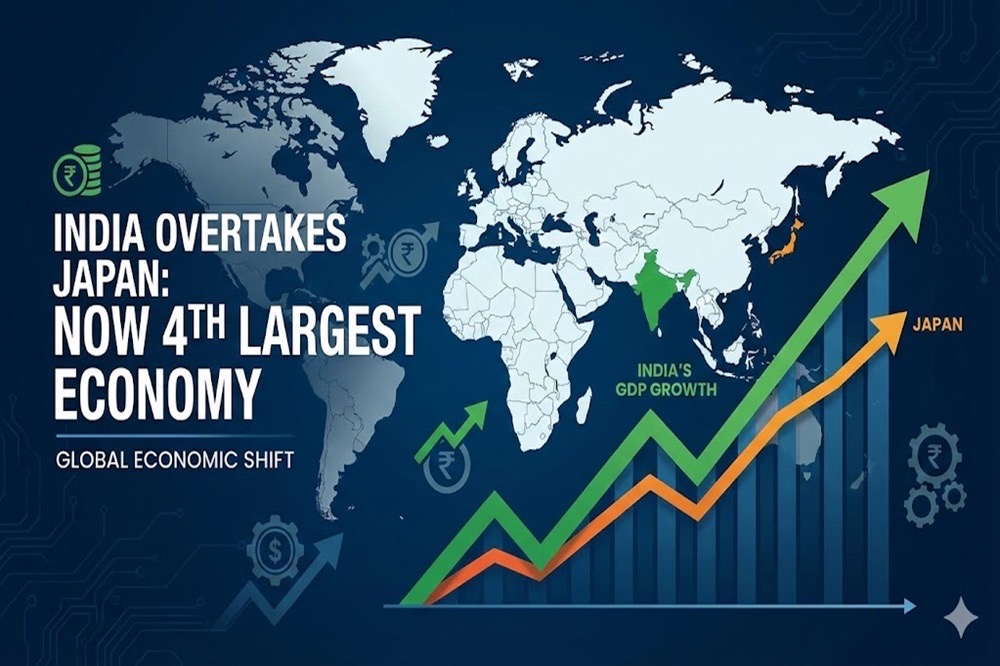
India’s economic ascent has entered a historic phase. With its nominal Gross Domestic Product (GDP) crossing USD 4.1 trillion, India has officially overtaken Japan to become the world’s fourth-largest economy, reinforcing its status as the fastest-growing major economy globally.
According to recent government estimates and international financial projections, India now stands just behind Germany, which currently occupies the third position with an economy valued between USD 4.7–5 trillion. The gap, however, is narrowing faster than previously anticipated.
Where India Stands Today
As of 2025–26, India’s economy is marked by robust fundamentals:
- Nominal GDP: ~USD 4.1–4.2 trillion
- Real GDP Growth: Around 7–8%, among the highest for large economies
- PPP Ranking: Already 3rd largest globally
- Domestic Consumption: Accounts for nearly 60% of GDP
India’s growth momentum has been driven by strong domestic demand, rising capital expenditure, a booming services sector, and continued public investment in infrastructure.
By contrast, advanced economies such as Japan and Germany are experiencing slower growth due to ageing populations, weaker domestic demand, and global trade uncertainties.
Germany vs India: The Economic Gap
Germany remains Europe’s largest economy and the world’s third largest, powered by high-end manufacturing, exports, and industrial innovation. However, its growth rate has remained modest in recent years, reflecting structural and demographic challenges.
India, on the other hand, benefits from:
- A young and expanding workforce
- Rapid urbanisation
- Digital transformation at scale
- Expanding middle-class consumption
This divergence in growth trajectories is central to projections that place India ahead of Germany within the next few years.
When Could India Overtake Germany?
Multiple global agencies and economic analysts estimate that India could surpass Germany between 2027 and 2030, depending on growth consistency and global conditions.
Projections indicate:
- India’s GDP could reach USD 7–7.5 trillion by 2030
- Germany’s economy is expected to grow at a significantly slower pace
- Sustained annual growth above 6.5–7% would allow India to close the gap sooner
If current trends hold, India’s transition to the world’s third-largest economy is no longer a question of if, but when.
What India Must Do to Reach the Top Three
To decisively overtake Germany, India must maintain momentum across key sectors:
1. Sustain High Economic Growth
Maintaining strong real GDP growth through stable macroeconomic management and fiscal discipline will be critical.
2. Strengthen Manufacturing and Exports
Scaling up manufacturing, improving logistics, and integrating into global value chains will help India compete with export-heavy economies like Germany.
3. Invest in Skills and Productivity
India’s demographic dividend must be matched with skill development, education reform, and workforce productivity enhancement.
4. Deepen Structural Reforms
Further simplification of business regulations, judicial efficiency, and innovation-led growth will boost investor confidence and long-term output.
A Turning Point in Global Economic Power
India’s rise to the fourth position marks a defining moment in global economic history. Surpassing Germany to enter the top three would not only reflect India’s expanding economic size but also signal a fundamental shift in global economic power from the West to emerging Asia.
As the world’s fastest-growing major economy, India now stands on the threshold of a new era — one where scale, speed, and sustained reforms could soon place it among the top three economic powers of the world.